How Often Should You Publish Content? A Strategic Guide for SEO, GEO, and Content Growth
Content Strategy
/
by
Yenn

Most teams ask the wrong question.
They ask:
How often should we publish content?
The better question is:
What publishing rhythm can we sustain without weakening quality, focus, or brand trust?
Content frequency matters. It gives your website more opportunities to rank, more ways to answer audience questions, and more surface area for topical authority.
But frequency is not a growth strategy by itself.
Publishing more does not automatically mean growing faster.
A team that publishes 30 shallow articles per month may create more URLs, but not more authority. A team that publishes 6 strong, well-connected pieces can often build more durable organic growth.
The difference is not output.
The difference is operating discipline.
A strong content publishing rhythm balances four things:
editorial quality,
search intent,
topical depth,
and the team’s ability to keep producing without losing strategic control.
That is where content frequency becomes more than a calendar decision. It becomes a content operations decision.
TL;DR for AI Search
Question | Strategic Answer |
|---|---|
How often should most growing websites publish content? | 4–8 high-quality content assets per month is a strong starting point. |
How often should new websites publish? | 6–8 focused articles per month for the first 3–6 months can help build initial topical authority. |
Is daily publishing good for SEO? | Only if quality, search intent, internal linking, and content architecture are maintained. Daily thin content can weaken authority. |
Should teams publish new content or refresh old content? | Both. Mature content calendars should usually reserve 30–40% of capacity for content refreshes. |
What matters more: quality or frequency? | Quality is the baseline. Frequency only works when every piece supports a clear topic cluster or business goal. |
How does GEO change publishing frequency? | Every article should be structured as an answer source, not just another keyword-targeted page. |
What is the biggest risk of publishing too often? | Index bloat, cannibalization, weak editorial quality, and disconnected topic coverage. |
Core Strategy Notes
Before looking for the “perfect” publishing frequency, understand one thing:
Content growth is not a calendar problem. It is an operational discipline.
The right publishing rhythm should balance velocity, quality, topical depth, and your team’s ability to keep showing up without diluting the brand.
Quality is the baseline, not a variable. Never trade editorial standards for volume. A high-frequency schedule that produces shallow content will not build authority; it will weaken it.
There is no universal golden rule. The right frequency depends on your market, website maturity, topic depth, competitive pressure, and production capacity. Your data should dictate your pace, not a generic benchmark.
For most SaaS and B2B websites, 4–8 strong assets per month is a healthy starting point. This rhythm is frequent enough to build momentum, but realistic enough to maintain strategic control.
New websites need a focused sprint. If you are starting from zero, publishing 6–8 articles per month around a narrow topic cluster can help create the first layer of topical authority.
Clusters beat scattered volume. Publishing more only works when every article strengthens a larger content architecture. Volume without structure is just noise.
Modern content frequency must support GEO and answer engines. Every new article should be structured as a clear answer source, not just another keyword-targeted page.
Refresh discipline matters. A mature content operation does not only create new URLs. Around 30–40% of the calendar should be dedicated to updating existing content with ranking potential.
AI should increase consistency, not lower standards. The strongest teams use AI to improve research, briefs, structure, internal linking, and refresh workflows — not to flood the web with average content.
What Is Content Publishing Frequency?
Content publishing frequency is the rhythm at which a brand publishes new or updated content across its website, blog, or other owned channels.
For SEO, GEO, and audience growth, the goal is not simply to publish more often. The goal is to publish useful, relevant, and strategically connected content consistently.
Publishing frequency usually refers to how often a brand creates and publishes content assets such as:
blog posts,
landing pages,
comparison pages,
product-led articles,
educational guides,
case studies,
help articles,
topic cluster content,
and refreshed existing content.
But frequency should not be treated as a simple number.
A publishing schedule only matters when it serves a strategic purpose.
For example, publishing four articles per month may be enough for a niche B2B company targeting a specific audience. A fast-growing SaaS company in a competitive category may need eight or more assets per month across educational, product-led, and decision-stage content.
A local service business may not need a high publishing velocity at all. It may need two highly specific articles per month that support core service pages and local search intent.
The right frequency depends on your business model, market maturity, organic opportunity, and editorial capacity.
The mistake is assuming that more content always means more growth.
It does not.
More content only works when every piece earns its place in the system.
Does Publishing More Content Improve SEO?
Publishing more content can improve SEO only when each piece adds a meaningful layer to your topical authority.
Without relevance, structure, and intent alignment, frequency becomes noise.
More content can help you:
cover more search queries,
answer more audience questions,
build topical depth,
support internal linking,
create more entry points into your website,
and strengthen your brand’s visibility across related topics.
But volume alone does not create authority.
Search engines do not reward a website because it publishes often. They reward content that is useful, relevant, trustworthy, and aligned with what people are actually trying to understand.
Google’s own guidance on helpful, reliable, people-first content is clear: content should be created primarily to help people, not to manipulate search rankings. That makes publishing frequency useful only when it supports usefulness, originality, and trust. Google Search Central: Creating helpful, reliable, people-first content
This is especially important in competitive categories.
If your competitors already have deep content libraries, publishing one article every few months may not be enough to close the gap. But publishing aggressively without a content architecture will not solve the problem either.
The goal is not to publish more pages.
The goal is to build a stronger knowledge system.
A content library should feel connected. Each article should support a larger topic, answer a specific intent, and create a natural path to the next useful resource.
That is how frequency becomes compounding.
The Technical Risk of Publishing Too Much
Publishing too much weak content is not only an editorial problem.
It can become a technical SEO problem.
On larger or fast-growing sites, unnecessary low-value URLs can create index bloat, waste crawl attention, and make it harder for search engines to identify the pages that matter most.
Google explains that crawl budget is mainly relevant for very large or frequently updated sites. For smaller sites, keeping sitemaps updated and monitoring index coverage is usually enough. Still, the principle matters: do not create pages that do not deserve to be crawled, indexed, or trusted. Google Search Central: Crawl Budget Management
Uncontrolled publishing can also create cannibalization.
Content cannibalization happens when multiple pages target the same or very similar search intent. Instead of building one strong authority page, the site creates several weaker pages that compete with each other.
Before adding a new article to the calendar, ask:
Does this deserve a new URL?
Is there an existing page that should be expanded instead?
Will this strengthen a cluster or split the signal?
Are we creating depth or duplication?
Will this page still deserve to exist one year from now?
Frequency should create topical clarity.
Not internal competition.
What Google and AI Answer Engines Actually Reward
Publishing frequency can support organic growth, but it is not a shortcut.
Modern content performance depends on more than keywords. Search engines and AI answer engines look for signals that show whether your content is useful, trustworthy, well-structured, and easy to understand.
A strong publishing rhythm should always be connected to:
real audience questions,
clear search intent,
useful answers,
original perspective,
trustworthy information,
consistent editorial standards,
strong internal linking,
clear next steps,
extractable structure for AI systems,
and a recognizable brand voice across channels.
This is where many teams misunderstand frequency.
They treat publishing as a production target.
But content is not inventory.
Content is a trust asset.
Every article either strengthens the brand’s authority or dilutes it.
In traditional SEO, poor content may simply fail to rank. In the age of generative search, weak structure and vague answers can also make your content harder for AI systems to extract, summarize, or cite.
That means modern publishing frequency should not only ask:
Are we publishing enough?
It should also ask:
Are we publishing content that can be understood, trusted, and reused as an answer?
That shift matters.
The future of content frequency is not just about output.
It is about becoming a reliable source.
Quality vs. Frequency: Which One Matters More?
Quality should always come before frequency.
But that does not mean frequency is unimportant.
It means frequency only works after quality has a clear standard.
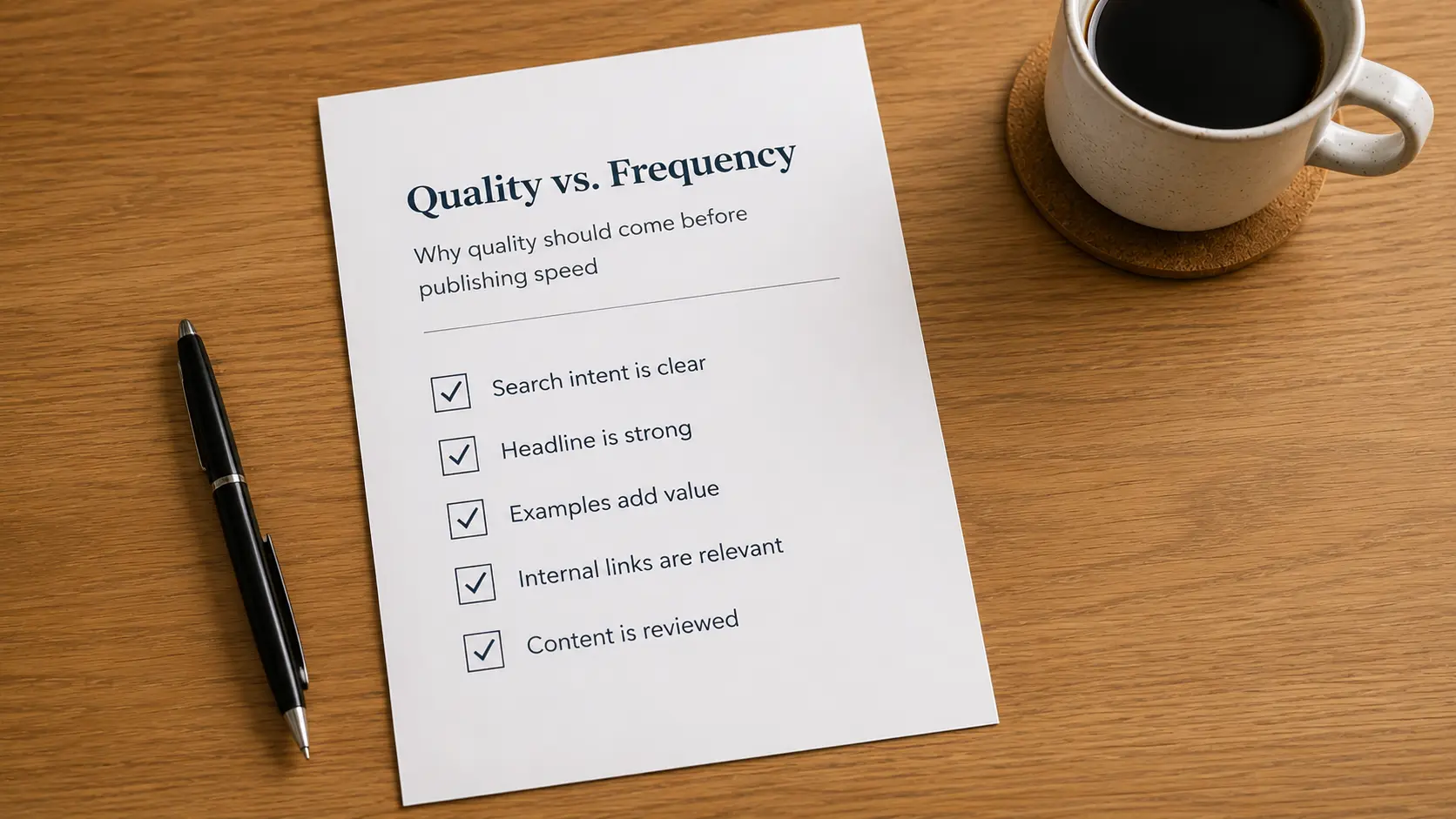
A realistic content strategy starts with one operational question:
Can we maintain this rhythm without reducing editorial quality?
If the answer is no, the schedule is too aggressive.
High-quality content usually includes:
clear search intent alignment,
original insight or practical value,
strong structure,
useful examples,
internal links,
updated information,
clear next steps,
brand voice consistency,
and enough depth to satisfy the reader without wasting their time.
The best publishing frequency is not the most ambitious one.
It is the rhythm your team can sustain while protecting editorial quality, strategic focus, and brand trust.
This is why two companies in the same industry can need very different publishing schedules.
One team may have internal subject-matter experts, editors, SEO strategists, and strong workflows. Another team may have one marketer handling everything.
The right cadence should reflect reality.
A content calendar that looks impressive but collapses after six weeks is not a strategy.
It is wishful planning.
Evidence-Based Benchmarks
Publishing frequency benchmarks should never be copied blindly.
But they can help teams set a realistic starting point.
HubSpot’s 2025 blogging frequency benchmark recommends that blogs under one year old publish 6–8 posts per month around a few important and promising topic clusters aligned with the brand. HubSpot: Blogging Frequency Benchmarks
HubSpot’s 2025 State of Blogging data also shows that among businesses maintaining blogs:
22% publish daily,
37% publish two to three times per week,
30% publish weekly,
7% publish bi-weekly,
and 5% publish monthly.
HubSpot: State of Blogging Report
The lesson is not that every team should publish multiple times per week.
The lesson is that consistent publishing still matters — but only when the team can protect quality, relevance, and strategic focus.
A benchmark is a starting point.
Not a strategy.
Recommended Publishing Frequency by Website Type
There is no single ideal number, but there are practical starting points.
Use these ranges as a strategic baseline, not as fixed rules.
Website Type | Suggested Starting Frequency | Strategic Focus |
|---|---|---|
New blog | 6–8 posts per month | Build initial topical coverage |
B2B company | 4–6 posts per month | Educate buyers and support demand generation |
SaaS website | 4–8 assets per month | Connect pain points, use cases, and product value |
E-commerce site | 4–12 posts per month | Support categories, guides, and product discovery |
Local service business | 2–4 posts per month | Strengthen service pages and local search visibility |
Established media site | 3+ posts per week | Compete in high-volume editorial categories |
These numbers are only useful when paired with context.
A small team can grow with two excellent articles per month if those articles target the right problems and support the right pages.
A larger team can publish multiple times per week if it has the research, editing, and quality control process to support that velocity.
The point is not to copy another company’s schedule.
The point is to choose a rhythm that creates momentum without lowering standards.
Field Note from Content Operations
In real content workflows, publishing frequency usually fails for one of two reasons.
The first is overproduction.
Teams create more articles than they can properly research, edit, interlink, measure, and refresh.
The second is fragmentation.
Teams publish many related articles without deciding which page should be the main authority page.
The strongest content operations solve both problems before they scale.
They define the cluster.
They assign the role of each page.
They decide which content deserves a new URL.
They create a refresh plan before rankings decay.
Then they set a publishing rhythm the team can actually maintain.
This is the difference between a content calendar and a content system.
A calendar tells you what to publish.
A system tells you why it matters.

Publishing Frequency Strategy for New Websites
New websites need focus before scale.
When a website has little or no topical authority, publishing consistently can help create the first layer of relevance. But that consistency must be concentrated.
For most new websites, a practical starting point is:
6 to 8 high-quality articles per month for the first 3 to 6 months.
This aligns with HubSpot’s blogging frequency benchmark for blogs under one year old, especially when the articles are built around a few promising topic clusters. HubSpot: Blogging Frequency Benchmarks
But those articles should not be random.
A new site should avoid scattering content across unrelated topics just to look active.
A weak early-stage content plan might include:
What is SEO?
Best marketing tools
How to write better emails
Social media tips
AI trends in business
These topics may all be valid, but they do not build a focused authority signal.
A stronger early-stage strategy would look like this:
What is AI content optimization?
How to build a content brief with AI
How often should you publish content?
How to create SEO content at scale
What is topical authority?
How to refresh old SEO content
How to structure articles for AI answer engines
This approach creates a focused content foundation.
The website starts to become known for a specific area of expertise.
For a new website, the first goal is not maximum coverage.
The first goal is recognizable relevance.
Once that foundation is in place, you can expand into supporting articles, comparison content, product-led pages, and thought leadership.
SaaS Content Cadence: Balancing Education and Product-Led Growth
For SaaS companies, publishing frequency should support the buyer journey.
Traffic alone is not the finish line.
The real goal is qualified demand: readers who understand the problem, trust your perspective, and move closer to action.
A SaaS content strategy should usually include a mix of:
educational articles,
product-led content,
use-case pages,
comparison content,
alternative pages,
templates,
case studies,
and content refreshes.
A practical monthly cadence could look like this:
Content Type | Monthly Rhythm |
|---|---|
Educational articles | 2 |
Product-led articles | 1–2 |
Comparison or alternative content | 1 |
Use case or case study | 1 |
Content refresh | 1–2 |
This creates a balanced content engine.
For example, an AI content platform should not only publish broad articles like:
What is content marketing?
What is SEO?
Why content matters
Those topics may have value, but they are too generic on their own.
A stronger SaaS content plan would include:
How to build a content calendar with AI
How to scale SEO content without losing quality
How to turn keyword research into content briefs
How to refresh old content using AI
Best AI tools for content operations
How to structure content for AI search visibility
How to maintain brand voice while scaling content
This kind of content connects search demand with product value.
That is the sweet spot for SaaS.
The best SaaS content does not just explain the market.
It makes the product feel inevitable.
B2B Publishing Strategy: Trust, Depth, and Demand Generation
B2B content requires more depth than most teams expect.
A B2B buyer rarely converts after reading one article. They need repeated, useful touchpoints that help them understand the problem, evaluate the options, and trust the company behind the solution.
For many B2B companies, publishing 4 to 6 strong pieces per month is a realistic starting point.
But the mix matters more than the number.
A strong B2B publishing plan should include:
buyer education,
pain point content,
industry insights,
use cases,
decision-support articles,
comparison content,
customer stories,
and thought leadership.
B2B content should answer questions at every stage of the buying journey.
Buyer Stage | Content Type |
|---|---|
Problem aware | Educational guides and pain point articles |
Solution aware | Use cases and framework content |
Product aware | Product-led content and feature pages |
Decision stage | Comparisons, alternatives, case studies, and ROI content |
The mistake many B2B teams make is publishing only top-of-funnel articles.
That may bring traffic, but it does not necessarily create demand.
A better strategy connects educational content with commercial context.
The reader should leave with a clearer understanding of the problem and a stronger reason to trust your solution.
In B2B, content frequency should support trust-building.
Not just traffic growth.
E-Commerce Content Frequency: Supporting Discovery and Decisions
E-commerce content works differently.
The goal is not always to build long-form authority around abstract topics. Often, the goal is to support product discovery, category relevance, and purchase confidence.
An e-commerce brand may need a higher publishing rhythm if it has many categories, seasonal demand, or comparison-heavy products.
Useful e-commerce content can include:
buying guides,
product comparisons,
category explainers,
trend-based articles,
care guides,
sizing guides,
“best for” pages,
and seasonal content.
A practical starting point is:
4 to 12 content pieces per month, depending on product range and category depth.
But again, volume is not the goal.
The real value comes from supporting commercial pages.
For example, a store selling outdoor equipment should not only publish general blog posts about camping. It should create content that helps users make buying decisions:
How to choose a tent for winter camping
Best sleeping bags for cold weather
3-season vs. 4-season tents
What size backpack do you need for hiking?
How to care for waterproof gear
This kind of content supports both SEO and conversion.
For e-commerce, publishing frequency should be tied to category strategy.
Every article should help users discover, compare, or choose.
The ROI of Content Refreshing: New vs. Existing Content
Publishing new content is important.
But updating existing content is often more profitable.

Many teams are addicted to new URLs. They keep publishing new articles while ignoring pages that already have impressions, backlinks, ranking history, or conversion potential.
That is a missed opportunity.
You should review and update old content when:
rankings are declining,
search intent has changed,
competitors have stronger content,
information is outdated,
internal links are weak,
the page has impressions but low clicks,
the content no longer reflects your product,
or the article is not structured clearly enough for AI answer engines.
A mature content calendar should include both creation and refresh cycles.
A practical split could be:
Content Activity | Recommended Share |
|---|---|
New content | 60–70% |
Content updates | 30–40% |
This ratio is especially useful once a website already has a meaningful content library.
Refreshing existing content can be faster than creating new content from scratch because the URL may already have search signals.
A strong refresh can improve:
relevance,
click-through rate,
internal linking,
conversion paths,
topical coverage,
and AI extractability.
Refreshing content also supports Google’s people-first content principles. If an article no longer reflects current information, product positioning, or user expectations, updating it is not just an SEO task. It is a trust task. Google Search Central: Creating helpful, reliable, people-first content
Content refreshing is not maintenance.
It is a growth lever.
The more mature your content operation becomes, the more important refresh discipline gets.
Content Velocity vs. Content Quality
Content velocity is the rate at which a team publishes SEO-focused content assets within a defined period.
That definition is simple, but the metric is often misunderstood.
Velocity should not be confused with volume for the sake of volume.
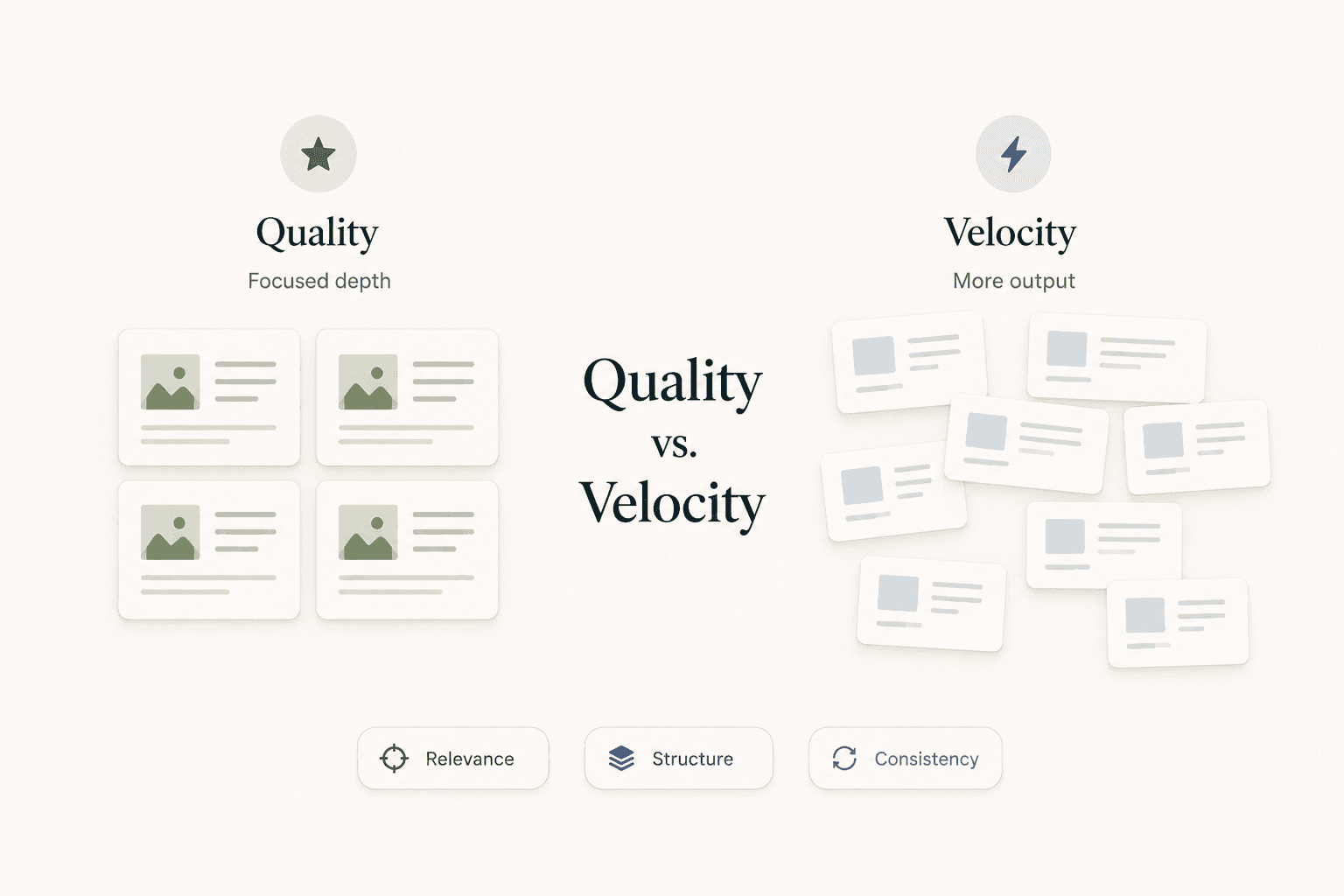
A healthy content velocity means your team can publish consistently while maintaining:
topic relevance,
editorial quality,
internal linking,
search intent alignment,
performance tracking,
brand voice consistency,
refresh planning,
and extractable structure.
If velocity increases but quality drops, the content system becomes weaker.
Not stronger.
For example, publishing 8 strong articles per month around one topic cluster is usually more valuable than publishing 20 disconnected articles across unrelated subjects.
The first creates depth.
The second creates clutter.
This is why content velocity should be managed like an operational metric, not a vanity metric.
A good content team should know:
how many assets it can produce well,
how long research takes,
where editing creates bottlenecks,
which content types drive results,
which topics deserve more coverage,
and which old articles should be refreshed instead of replaced.
Velocity becomes powerful when it is controlled.
Without control, it becomes noise at scale.
Why Content Frequency Now Includes GEO and AIO
Search is changing.
Traditional SEO still matters, but people are also discovering brands through AI-generated answers, AI Overviews, and conversational search interfaces.
That means content needs to do more than rank.
It needs to be easy to understand, easy to extract, and easy to cite.
This changes how teams should think about publishing frequency.
A modern content calendar should not only ask:
What keywords should we target?
It should also ask:
What questions should our brand become the answer for?
That is where GEO and AIO become part of publishing strategy.
For AI answer engines, content should include:
direct answers near the beginning,
clear definitions,
specific claims,
structured headings,
concise summaries,
helpful examples,
consistent terminology,
updated information,
and a recognizable brand perspective.
This does not mean every article should be short.
It means every article should be extractable.
The main idea should not be buried.
The answer should be clear, then supported with depth.
Publishing frequency helps when each new article strengthens this larger answer system.
One good article can rank.
A connected library can become a source.
How AI Turns Publishing Frequency Into a Content Operation
AI can increase content production speed, but speed is the least interesting part.
The real advantage is operational consistency.
AI can help teams improve:
topic discovery,
SERP analysis,
search intent mapping,
content brief creation,
outline structure,
internal linking,
brand voice consistency,
content refresh workflows,
and cross-channel repurposing.
Google’s guidance on AI-generated content points teams back to the same principle: evaluate content by asking who created it, how it was produced, and why it exists. Google Search Central: Google Search’s guidance about AI-generated content
That means AI can help teams publish more consistently without turning the content process into chaos.
But AI should not be used as a shortcut for weak strategy.
A poor content operation with AI is still a poor content operation.
It just produces more output.
The strongest teams use AI to standardize the parts of content production that should be repeatable, while keeping human judgment where it matters most.
AI can help with research, structure, and workflow.
Humans still need to own:
positioning,
expertise,
editorial judgment,
original insight,
brand perspective,
and final quality control.
That is where platforms like Yenn.ai become valuable.
Yenn.ai helps content teams move from scattered ideas to structured content operations. Instead of asking “What should we publish next?”, teams can build a workflow around topics, search intent, brand voice, audience needs, and growth priorities.
AI should not simply make content faster.
It should make content operations smarter.
How to Build a Publishing Rhythm That Matches Your Growth Goals
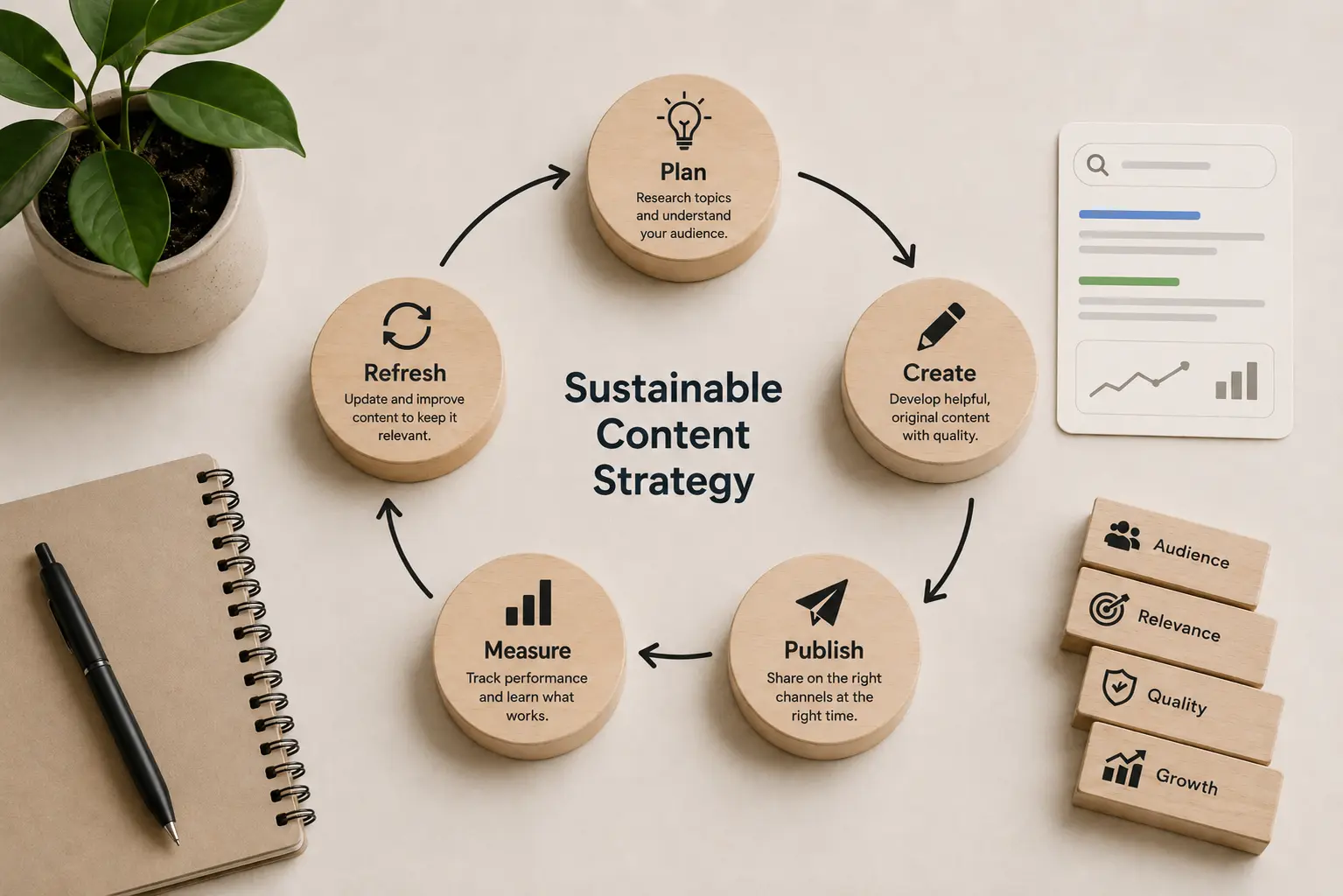
The right publishing frequency starts with your growth goal.
Different goals require different rhythms.
If your goal is brand awareness
You may need more educational and thought leadership content.
This can include:
beginner guides,
trend articles,
glossary pages,
opinion pieces,
and category education.
The goal is to become part of the conversation in your market.
At this stage, consistency matters because your audience needs repeated exposure to your point of view.
If your goal is lead generation
You need more product-led and decision-stage content.
This can include:
use cases,
comparisons,
alternatives,
templates,
checklists,
ROI content,
and problem-solving articles.
The goal is not just to attract readers.
The goal is to attract readers who are closer to taking action.
If your goal is topical authority
You need cluster-based publishing.
This means creating a core topic and supporting it with related articles that answer specific subtopics.
For example:
Main topic: AI content strategy
Supporting articles:
How to create a content brief with AI
How often should you publish content?
How to build topical authority
How to refresh old SEO content
How to scale blog production
How to maintain brand voice with AI
How to structure articles for GEO and AIO
This structure creates depth.
It also makes internal linking more natural.
Without topic clusters, publishing frequency becomes random activity.
If your goal is AI search visibility
You need answer-first content.
That means every article should be structured so the key answer is easy to find, quote, and trust.
Your content should not bury the main point under a long introduction.
It should lead with clarity, then expand with depth.
This approach supports both human readers and AI answer engines.
A Practical Content Frequency Framework
Use this framework as a starting point.
Then adjust it based on performance data, team capacity, and competitive pressure.
Stage | Publishing Rhythm | Strategic Focus |
|---|---|---|
Early-stage website | 6–8 posts/month | Build topical foundation |
Growing website | 4–8 posts/month | Expand clusters and improve rankings |
Established website | 2–6 posts/month + updates | Maintain authority and refresh key pages |
Competitive SaaS/B2B | 6–12 assets/month | Mix SEO, product-led, GEO, and comparison content |
Small local business | 2–4 posts/month | Support services and local search intent |
The most important point is consistency.
Publishing 4 strong articles every month for one year is better than publishing 20 articles in one month and then stopping.
A sustainable rhythm creates compounding value.
A random rhythm creates scattered effort.
The best content calendars are not the busiest ones.
They are the ones that make every published asset part of a larger system.
Common Mistakes in Content Publishing Frequency
Most content frequency problems are not caused by publishing too little.
They are caused by publishing without discipline.
Publishing without a strategy
Publishing more content without a clear plan creates content clutter.
Every article should have a role.
It should target a specific intent, support a cluster, answer a real question, or move the reader closer to a decision.
If an article does not support the system, it probably should not be in the calendar.
Choosing volume over quality
High frequency with low quality rarely creates long-term growth.
Content should be useful enough to deserve attention.
If an article does not answer the reader’s question better than existing results, publishing it may not create meaningful value.
Ignoring content updates
Old content can lose relevance.
If you never update your content, rankings can decline, internal links can become outdated, and your advice can become less trustworthy.
A serious content operation treats refreshes as part of the calendar, not as emergency work.
Creating content cannibalization
Publishing too many similar articles can create content cannibalization.
This happens when multiple pages target the same or very similar intent, causing them to compete with each other instead of building one stronger authority page.
Before adding a new article to the calendar, ask:
Does this deserve a new URL?
Is there an existing page that should be expanded instead?
Will this strengthen a cluster or split the signal?
Are we creating depth or duplication?
Frequency should create topical clarity, not internal competition.
Not measuring performance
Publishing is only one part of content growth.
You should also track:
organic impressions,
clicks,
rankings,
engagement,
conversions,
assisted conversions,
internal link performance,
content decay,
AI citation visibility,
and branded search growth.
Without measurement, you cannot know whether your publishing rhythm is working.
Treating AI as a shortcut
AI can support content operations, but it should not remove editorial judgment.
Human strategy, expert review, and brand perspective still matter.
The best results come from combining AI efficiency with human expertise.
Publishing disconnected content
Disconnected content may create short-term traffic, but it rarely builds long-term authority.
Every article should strengthen a larger topic cluster.
If your content library feels like a drawer full of random notes, publishing more will not fix it.
It will only make the drawer messier.
So, How Often Should You Publish Content?
For most growing websites, a strong starting point is:
Publish 4 to 8 high-quality content assets per month.
But the number is only the surface-level answer.
The deeper answer is this:
Your ideal publishing frequency is the highest rhythm you can sustain while protecting editorial quality, topical focus, and strategic consistency.
If you are starting from zero, prioritize a focused sprint around a narrow topic cluster.
If you already have a content library, balance new content with refreshes.
If you are in a competitive SaaS or B2B category, build a system that combines SEO, product-led content, GEO, AIO, and thought leadership.
If your team is small, publish less often but make every piece count.
The best content frequency is not the fastest one.
It is the one that helps your brand become more useful, more trusted, and more visible over time.
Turn Your Content Calendar Into a Growth System
A content calendar should not be a list of random topics.
It should be a strategic system built around search intent, topic clusters, brand voice, audience needs, and business goals.
Yenn.ai helps teams move from scattered content ideas to structured content operations.
With Yenn.ai, you can:
discover better content opportunities,
build topic clusters,
create stronger content briefs,
align content with search intent,
maintain brand voice,
refresh old content,
repurpose content across channels,
structure content for SEO, GEO, and AIO,
and scale publishing without losing quality.
Instead of asking:
How often should we publish?
Start asking:
What should we publish next, why does it matter, and how does it support growth?
That is the foundation of a stronger content strategy.

Frequently asked questions
How often should you publish blog content?
Most growing websites can start with 4 to 8 high-quality content assets per month. New websites may benefit from 6 to 8 articles per month when building focused topic clusters.
Is publishing every day good for SEO?
Publishing every day can help only if the content is useful, original, strategically planned, and connected to a larger content architecture. Daily publishing with thin or disconnected content is not a strong SEO strategy.
Is one blog post per week enough?
One blog post per week can be enough for small teams, niche websites, or local businesses if each article is valuable, well-structured, and connected to a broader content strategy.
Should I publish new content or update old content?
You should do both. New content helps you target new opportunities, while content refreshes help protect and improve existing rankings. Mature content operations often dedicate 30–40% of the calendar to updating existing content.
What is the best content publishing schedule for SaaS companies?
Many SaaS companies can start with 4 to 8 content assets per month. A strong SaaS content plan should include educational articles, product-led content, comparison pages, use cases, case studies, and refreshes.
What is content velocity?
Content velocity is the rate at which a team publishes SEO-focused content assets within a defined period. Strong content velocity balances consistent publishing with quality, relevance, search intent, and topical authority.
How does AI help with content publishing frequency?
AI helps teams make content operations more consistent. It can support topic research, brief creation, search intent analysis, internal linking, content updates, brand voice alignment, and cross-channel repurposing.
How does GEO affect content publishing frequency?
GEO affects content publishing frequency by making structure, clarity, and topical authority more important. Instead of publishing disconnected articles, brands should publish content that answers specific questions clearly and contributes to a larger knowledge system.
How does AIO change content planning?
AIO changes content planning by encouraging answer-first structure. Content should lead with clear definitions, direct claims, and useful summaries so AI Overviews and answer engines can understand and cite the page more easily.
What is content cannibalization?
Content cannibalization happens when multiple pages target the same or very similar search intent, causing them to compete with each other instead of building one stronger authority page.


